Revisiting intellectual history of Chinese flora in Britain offers new perspectives on current issues such as environmental impact. I recently wrote a blog post on 18th century British trader John Bradby Blake's project of collecting Chinese plants and bring them back to Britain - and its little known impact on environment for the Bristol University's Environmental Humanities blog here.
Yuyin shanfang, Panyu, Guangzhou suburbs. Picture: J.Richard 2010, all rights reserved.
New approaches in Chinese garden history, conference abstract
19th June 2015, at the University of Sheffield
Josepha
Richard, PhD candidate, University of Sheffield, UK
"Cantonese gardens in the 19th
century"
Gardens
in Lingnan, particularly those located in and around Guangzhou (Canton), were
among the first Chinese gardens to be visited by Westerners, as until the Opium
Wars, movements of foreigners were restricted to the city of Guangzhou, with
the exception of a few missionaries who were able to enter Beijing. Thus Guangzhou
gardens, and more specifically the Co-Hong (or merchant) gardens of the 19th
century, have largely informed Western understanding of Chinese gardens at a
time when Suzhou gardens were inaccessible to foreigners. However, despite its
historical importance the Lingnan region has not been thoroughly explored by
Western scholars, and research in China has mostly seen local exposure. This
paper will present a conjectural reconstruction of Co-Hong merchant Howqua’s
garden, built at the beginning of the 19th century in the suburbs of
Guangzhou. This reconstruction is based on Western diaries, records and
photographs, as well as Chinese sources such as annals, export paintings and
poetry. Howqua’s garden is presented in the context of social life of late Qing
Guangzhou, when its inhabitants were developing a discourse of local culture in
the wake of the creation of the Xuehaitang Academy.
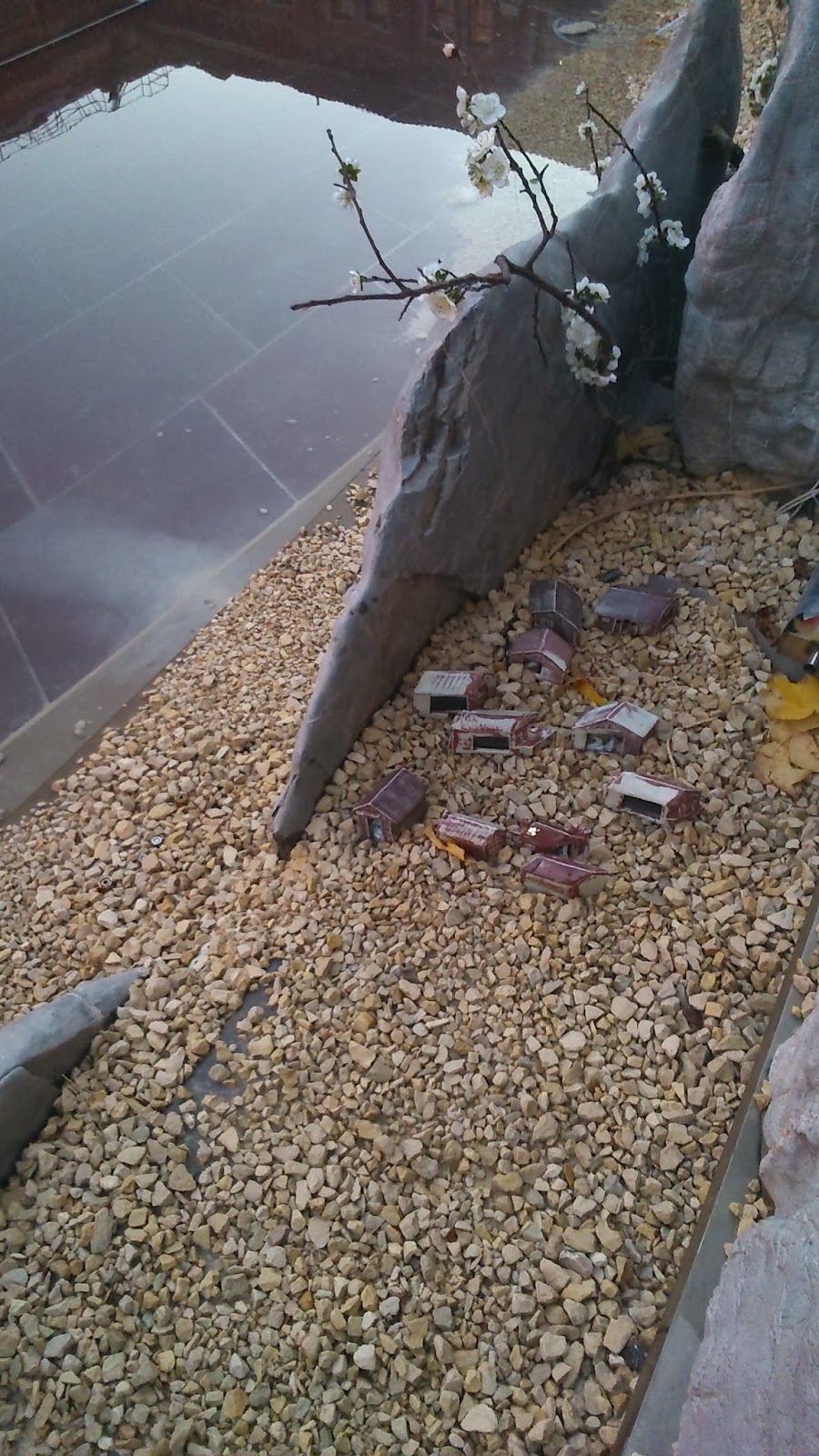
Today I wanted to share the experience of visiting 徐冰 Xu Bing's installation opened at the Victoria and Albert Museum at the occasion of the exhibition "Masterpieces of Chinese paintings 700-1900".
Picture: J.Richard. Installation belongs to Xu Bing and V&A Museum.
It opened on the 2d of November 2013 and will be available to visit for free until 2d of March 2014. The installation titled "Travelling to the Wonderland" is an idealised landscape inspired from Chinese landscape paintings, and therefore I consider it to be a Chinese garden. In the description of his work, the artist refers to a famous story by poet 陶渊明 Tao Yuanming (365–427), the Peach Blossom Spring (桃花源 Tao Hua Yuan).
To summarise the Peach Blossom Spring : A fisherman finds by chance the entrance to a wonderful world inside a cave as he is travelling in his boat. In this place, he briefly meets immortal beings living a quiet and idyllic life but as soon as he leaves the cave, he is incapable of finding the entrance again.
Numerous gardens in China contain references to this story, usually through calligraphy and poems as well as names. This does not seem surprising as the Peach Blossom Spring offers a strong symbol of the idealised life led in reclusion that many scholars seemed to aspire to in ancient China, and supposedly were trying to reproduce by building gardens.
You can visit the V&A website to find out more about the story behind the installation from Xu Bing himself, including a video. As for me, I wanted to point out a few interesting things I noticed during my brief visit of the installation just after it opened, on a clear evening.
First of all, the installation is mainly composed of rocks arranged around the original oval pond of the Victoria and Albert Museum's John Madejski Garden. The nature of the rocks used to create the landscape are different in the four corners of the garden (5 types in total); and each of these rocks seem to correspond to a popular type of rock used in Chinese gardens and rock collection in China (for example Taihu rocks). It especially appeals to me as this could refer to gardens of China as a whole, and not only those of the Jiangnan region near Suzhou (which are often understood as representative of Chinese gardens as a whole).
Secondly, the four corners of the garden seem to have each been attributed a specific season, and as you move along the garden you can experience a typical year in a Chinese garden. Well-designed Chinese gardens usually offer interesting sights in each season. I personally love to visit gardens during winter as it is the perfect time to assess their design; if the visit is dull then not enough effort has been put in this aspect, or the gardeners have neglected their seasonal work.
Thirdly, the little pavilions, statues and other sculptures scattered in the landscape might seem a bit childish at first, but these are a frequent addition to penjing (Chinese bonsai). Small-scaled buildings might allow you to feel as if the rock is suddenly a mountain, and you are experiencing a dreamy travel from the V&A garden to the foggy mountains of China.
The music, lights, video elements were not my favourite parts, as the installation seemed interesting without them, however they provide additional effects when the dark comes. I really appreciated the little ceramic fishes installed inside the pond.