About gardens in China, Chinese gardens outside China, Chinese architecture and heritage.
Showing posts with label Chinoiserie. Show all posts
Wednesday, 25 April 2018
"This Little Paradise": Aviaries in 18-19th century Guangzhou gardens
I am happy to have been given 4 pages to discuss 18-19th century Guangzhou aviaries in the latest issue of Historic Gardens Review! For now it is only a preview on their website and the physical journal, but in the future it will be available as an online article.
I notably included rare pictorial evidence of aviaries in Guangzhou and Macao, as well as comparisons with British vision of Chinese aviaries and their feathery inhabitants. I found that it was a good way to capture the difference between chinoiserie and actual examples of Chinese garden buildings with contemporary evidence!
For a taste of what the article starts with, I invite you to read Patrick Baty's blog post on the aviary at Dropmore Park. The aviary as illustrated by Barbara Jones, was made with tiles from Canton and in a style reminescent of Chambers' chinoiserie, but surprisingly appears relatively close to what a late 18th- early 19th century aviary in Guangzhou or nearby Macao might have looked like.
Labels:
Aviary,
British gardens,
Canton,
China,
China Trade,
Chinese architecture,
Chinese garden,
Chinese gardens,
Chinese History,
Chinoiserie,
East-West interactions,
Gardening history,
Guangzhou
Wednesday, 14 December 2016
Dates announced for the next conference on Chinese gardens & landscape! Oct 26/27th 2017
A conference co-organised by the Gardens Trust & the Department of Landscape (University of Sheffield)
Featuring engaging talks by specialists in several aspects of Chinese
gardens and landscapes (such as history, poetry, botany, social life,
layout).
The provisional program will be announced shortly!
Disclaimer: The previous announcement was off by one day, the conference is confirmed for 26-27th of October 2017.
Wednesday, 13 May 2015
Reduced delegate fee for the "New approaches in Chinese garden history" conference 19th June
19th JUNE 2015
We are pleased to announce that, thanks to the support of the Confucius Institute at Sheffield, we have been able to reduce the conference delegate rate for "New approaches in Chinese garden history".
This conference dedicated to Dr. Hardie on the occasion of her retirement will exceptionally bring together international scholars each interested in a different aspect of the Chinese garden and its wider theme: architecture, garden history, cultural history, translation studies, orientalism and chinoiserie, and the impact of Chinese gardens on the concept of English gardens.
The conference's schedule has been approved with a total of 7 academic speakers and 3 postgraduate speakers. Lunch and coffee breaks provided.
Student rate: £20
Delegate rate: £40
Full announcement here.
Book your seat here.
See also the Commented visit to Biddulph Grange on the 18th June here.
Sunday, 3 May 2015
Conference abstract: "Cantonese gardens in the 19th century"
Yuyin shanfang, Panyu, Guangzhou suburbs. Picture: J.Richard 2010, all rights reserved.
New approaches in Chinese garden history, conference abstract
19th June 2015, at the University of Sheffield
Josepha Richard, PhD candidate, University of Sheffield, UK
"Cantonese gardens in the 19th century"
Gardens
in Lingnan, particularly those located in and around Guangzhou (Canton), were
among the first Chinese gardens to be visited by Westerners, as until the Opium
Wars, movements of foreigners were restricted to the city of Guangzhou, with
the exception of a few missionaries who were able to enter Beijing. Thus Guangzhou
gardens, and more specifically the Co-Hong (or merchant) gardens of the 19th
century, have largely informed Western understanding of Chinese gardens at a
time when Suzhou gardens were inaccessible to foreigners. However, despite its
historical importance the Lingnan region has not been thoroughly explored by
Western scholars, and research in China has mostly seen local exposure. This
paper will present a conjectural reconstruction of Co-Hong merchant Howqua’s
garden, built at the beginning of the 19th century in the suburbs of
Guangzhou. This reconstruction is based on Western diaries, records and
photographs, as well as Chinese sources such as annals, export paintings and
poetry. Howqua’s garden is presented in the context of social life of late Qing
Guangzhou, when its inhabitants were developing a discourse of local culture in
the wake of the creation of the Xuehaitang Academy.
Tuesday, 28 April 2015
Commented visit to Biddulph Grange - 18th June 2015
Guided visit to Biddulph Grange garden - 18th June 2015
As part of the "New approaches in Chinese garden history" conference, the Department of Landscape of the University of Sheffield is hosting a commented visit to the Victorian garden of Biddulph Grange, Staffordshire (National Trust).
Created by James Bateman from the 1840s, the garden displays a series of Italian, Egyptian, Chinese and Himalayan themes, as well as an outstanding collection of worldwide plants. In relation to our conference, the vision of a Chinese garden as well as the "Great wall of China" exhibited in the garden will be our primary focus.
There will be a prepared visit commentary, however speakers and delegates of the conference - as well as participants - will be encouraged to give their personal input. For example our speaker Emile de Bruijn has researched the garden and as to Bianca Rinaldi, she has insight into the 'chinoiserie' concept, whereas Georges Métailié could comment on the choice of plants. Students will be able to ask questions and all present will voice their reflections as the visit unfolds.
The coach will depart at 9.30am sharp from the Geography & Town and Regional Planning car park behind the Arts Tower (next to the Mushroom Lane bus 95 stop), University of Sheffield, Western Bank S10 2TN. We are aiming to return to Sheffield in the early afternoon after the commented visit, in time for all to take a break before the evening conference dinner (optional, on booking only) in town.
Delegate (£20) and student (£10) fees available.
You are more than welcome to join in directly at Biddulph Grange but will need to pay full fee for your coach seat if you need a space on the return coach.
National Trust page for Biddulph Grange HERE.
Bookings available HERE.
Enquiries such as mobility issues should be directed to Josepha Richard: j.richard@sheffield.ac.uk
The coach will depart at 9.30am sharp from the Geography & Town and Regional Planning car park behind the Arts Tower (next to the Mushroom Lane bus 95 stop), University of Sheffield, Western Bank S10 2TN. We are aiming to return to Sheffield in the early afternoon after the commented visit, in time for all to take a break before the evening conference dinner (optional, on booking only) in town.
Delegate (£20) and student (£10) fees available.
You are more than welcome to join in directly at Biddulph Grange but will need to pay full fee for your coach seat if you need a space on the return coach.
National Trust page for Biddulph Grange HERE.
Bookings available HERE.
Enquiries such as mobility issues should be directed to Josepha Richard: j.richard@sheffield.ac.uk
Friday, 24 April 2015
Conference abstract: "Translating the Chinese garden: the Western invention of a canon"
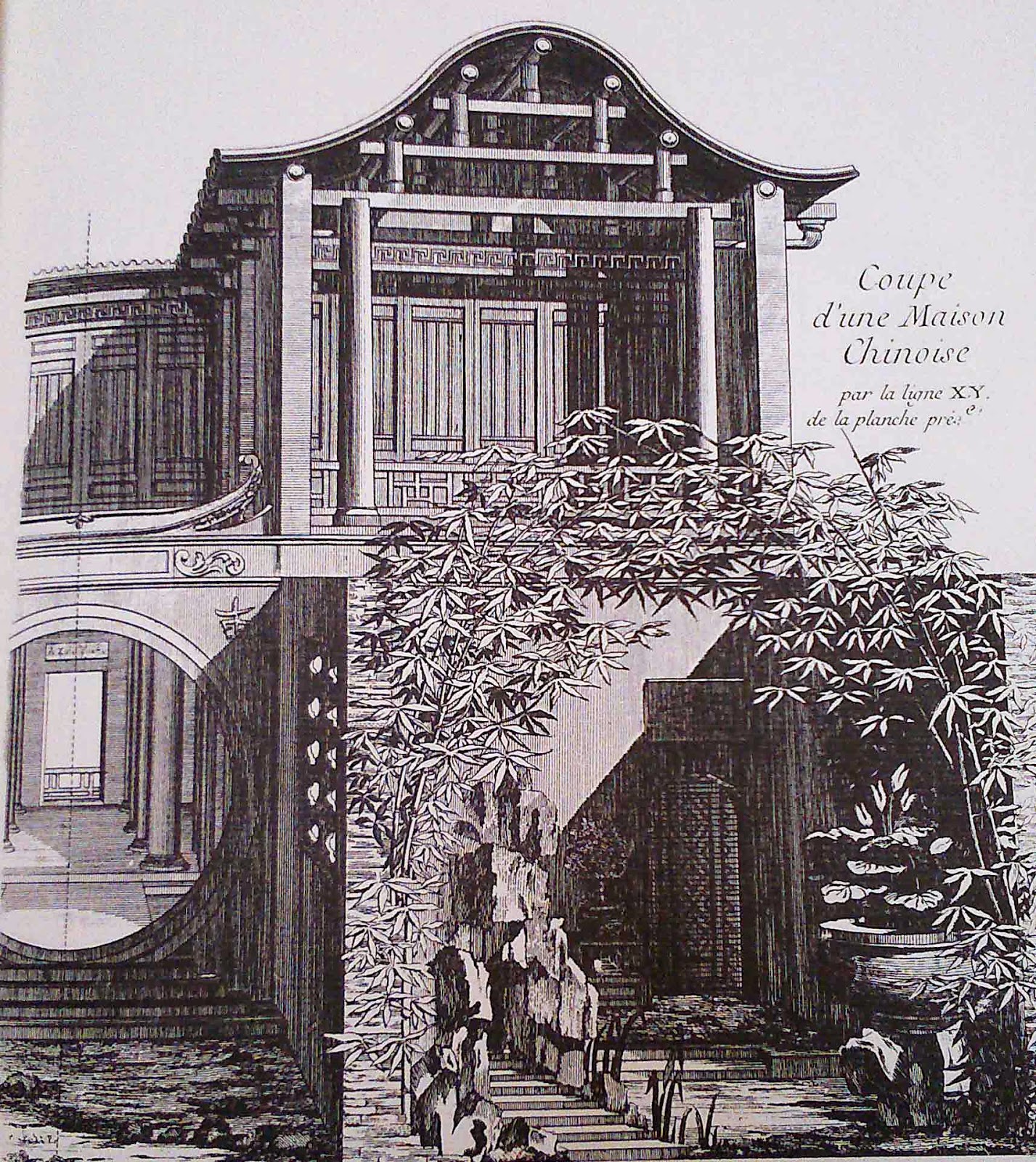
Picture: G. Le Rouge. V7. Coupe d'une maison chinoise... Jardins anglo-chinois, Cahier 5, BNF, Paris. Copyright may apply.
New approaches in Chinese garden history, conference abstract
19th June 2015, at the University of Sheffield
Bianca Maria Rinaldi, University of Camerino, Italy
"Translating the Chinese garden: the Western invention of a canon"
Categories are useful tools for
studies in garden history. The Italian renaissance garden, the English
landscape garden, the Picturesque garden, the anglo-chinois garden conjure up easily identifiable garden
typologies, chronologically defined and geographically determined, and they convey
immediately a precise visual image. The category of ‘Chinese Garden’ has blurred
contours, with its inclusive denomination proposes the Chinese garden as
invariable over time. However the definition of a Chinese garden aesthetic
seems to be based exclusively on a study of the gardens of the Jiangnan region,
regardless of any evolution and regional or stylistic differences.
The paper discusses how and when the
concept of the ‘Chinese Garden’ was invented in the West. The gardens of China
have been the focus of Western travelers’ accounts for centuries. During the eighteenth
century, some authors, such as the Jesuit Jean-Denis Attiret, William Chambers
and the Jesuit Pierre-Martial Cibot, made an intellectual effort to interpret
and convey Chinese garden design principles to their Western readers; while
later travellers, particularly British merchants and diplomats, simplified the
design of Chinese gardens in their descriptions and synthesised a formal
vocabulary.
Through an analysis of Western travellers’
accounts of the gardens of China, the paper will show that the late eighteenth
and nineteenth centuries were crucial periods in the Western invention of a
generic ‘Chinese Garden’. It will demonstrate that the restrictions of movement
that Westerners experienced in Qing China, the limited numbers of gardens they were
able to visit, as well as the memory of European chinoiserie, all encouraged simplistic interpretations, so that
Chinese garden aesthetic was associated with recurring elements that seemed to
convey a sort of shared image of Chineseness.
The paper argues
that the Western idea of a general and generic Chinese Garden influenced the
design of Chinese-style gardens built outside China from the 1970s onward, with
their repertoire of typical elements and the lack of the complexity in spatial
arrangement of the gardens in China.
See Bianca's academic profile at the University of Camerino here.
Read a review of her book The Chinese Garden here.
----
Conference abstract: "The changing significance of the Chinese taste in British gardens"
Picture: The Chinese garden in Biddulph Grange, 2012. Credit: L.Gu, All rights reserved.
New approaches in Chinese garden history, conference abstract
19th June 2015, at the University of Sheffield
Emile de Bruijn, National Trust, UK
"The changing significance of the Chinese taste in British gardens"
In the seventeenth century, China was held in high regard by
Europeans as a nation with an ancient history, a sophisticated system of
government and the ability to produce high quality goods. Europeans became
familiar with Chinese imagery through the decoration of porcelain, lacquer and
silk imported by the East India Companies. William Temple explicitly praised
Chinese gardens for their subtle asymmetry and artful naturalism, in an essay
published in 1685.
However, when British gardens did become more ‘natural’ in
the second quarter of the eighteenth century, there was no obvious evidence of
Chinese influence. Even so, the English landscape style was soon associated
with China, as evident in the French term jardin
anglo-chinois. The Chinese element was initially mainly expressed through
fanciful garden pavilions. The conceit of the Chinese garden was brought
indoors as well, with the use of Chinese wallpaper and chinoiserie furniture
with pagoda and fretwork motifs. Only towards the end of the eighteenth century
were actual Chinese plants introduced into British gardens.
In spite of the increasing material evidence of the real
China, nineteenth century examples of Chinese taste in British gardens were if
anything even more fantastical than their eighteenth-century forebears. The
Chinese section in the garden at Biddulph Grange, for instance, is reminiscent
of the Willow Pattern, a popular type of ceramics decoration created by British
manufacturers.
Recent studies have emphasised the rhetorical nature of the
chinoiserie style: how ‘China’ was used to express local and contemporary
concerns and how the meaning of ‘China’ changed in response to European
stylistic, social and intellectual developments. This paper will demonstrate
how that rhetoric operated in British gardens between the middle of the
seventeenth and the middle of the nineteenth century.
See Emile's professional Twitter account here.
Subscribe to:
Posts (Atom)